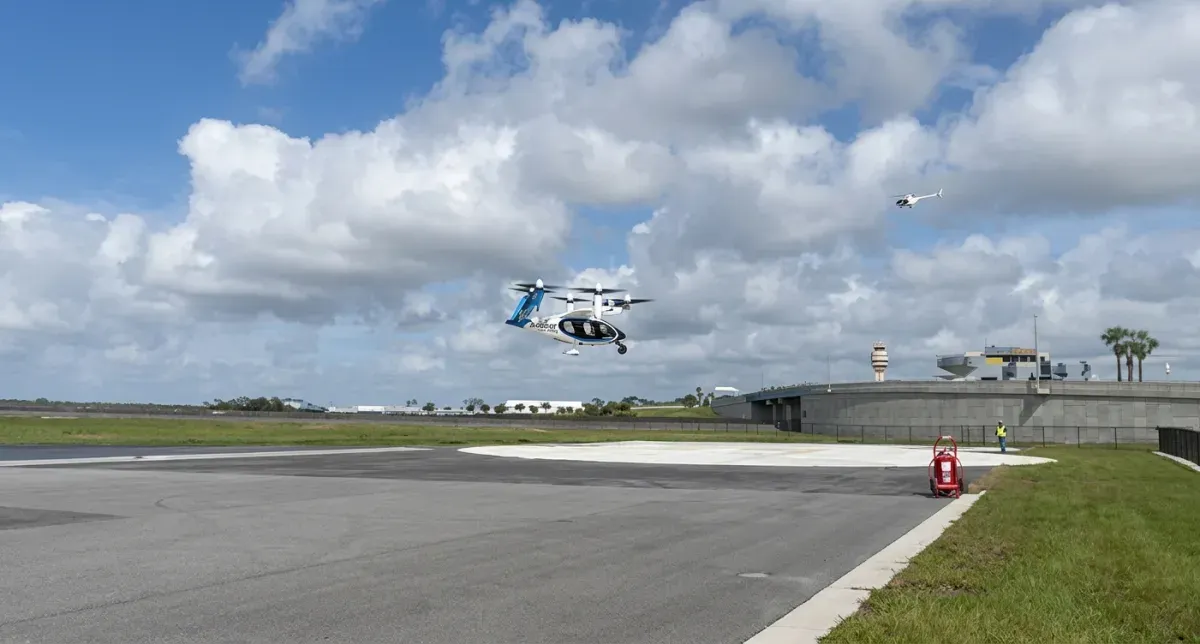
Joby Air Taxi Flies at Orlando Airport's First Vertipad
An electric air taxi flew at Orlando International Airport on Wednesday. It was the first use of a new landing pad that state and airport officials call the first of its kind at a commercial airport in the United States.
The Florida Department of Transportation (FDOT), the airport and Joby Aviation completed the flight, which was the state's second "flying car" test flight in its Future of Flight Series, according to an FDOT release. Joby flew its electric vertical-lift aircraft. The pad, called Vertipad Atlantis, is a small takeoff and landing area for advanced air mobility aircraft, Airport Improvement reported.
Officials said the flight showed that an air taxi can operate alongside normal airport traffic. Joby's Chief Policy Officer, Greg Bowles, said teams spent two years proving in a simulator that an air taxi could enter Class B airspace while the airport kept operating. He called the airport "the nation's first eVTOL landing site at a major U.S. airport." Routes and procedures were developed with the Federal Aviation Administration and NASA, and Orlando air traffic controllers took part, according to Airport Improvement.
"The Vertipad is laying groundwork" for a future vertiport for commercial operations, Airport Improvement reported. FDOT Secretary Jared Perdue said Florida is "paving the way for Florida's Aerial Highway Network." Lance Lyttle, CEO of the Greater Orlando Aviation Authority, said the demonstration reflects a commitment to preparing the airport for the future of aviation.
The Future of Flight Series recreates aviation milestones with new aircraft. The first flight recreated the world's first commercial airline flight, from 1914. More flights are planned across the state through early November. Florida will collect data on noise and airspace integration, and the FAA will use the findings to develop rules for commercial flying cars through its eVTOL integration pilot program.
The state wants the pad and other infrastructure to support the earliest commercial flights along the Interstate 4 corridor. Officials have not given a date for commercial service.